This blog provides firewall support tips to protect your PC. A tiny start-up of Israel has signed five major providers of Internet firewall to help keep hostile Java applets wreaking havoc on their networks.
Finjan Software, which opened offices in the U.S. in Silicon Valley this week announced deals to integrate its technology to block malicious applets SurfinGate with Check Point Software Technologies (CHKPF) FireWall-1, Raptor Systems (RAPT) Eagle firewall, Trusted Information Systems (TISX) Gauntlet firewall, Canadian company Milkyway Networks Black Hole Firewall, and Network-1 Software and Technology Fire Wall / Plus.
In addition, Finjan intends to work with Digital Equipment (DEC) to integrate Finjan applet scanning technology in their firewalls AltaVista and VeriSign to incorporate their digital IDs SurfinGate.
"We believe the content is examining how to protect users from hostile applets. We're like a 24-hour guard and alarm system, "Lior Arussy, vice president of Finjan's sales and marketing, told CNET." These partnerships are part of our intention to use our technology as the de facto standard in Java security. "
"Finjan provides an additional layer of security for Java applications that can be integrated into a security policy of the company using the API to our security platform," said Check Point spokeswoman Emily Cohen told CNET.
Finjan individual SURFINSHIELD SurfinGate and networking products combines a database of known hostile Java applets, which blocks the downloading to a hard drive of your PC or network, and scanning every input applet to determine if hostile. Finjan is seeking a patent on its technology, which he describes as an "enterprise level firewall.
Showing posts with label fix spyware problems. Show all posts
Showing posts with label fix spyware problems. Show all posts
Monday, September 14, 2009

Thursday, August 27, 2009
How to Remove Spyware Quake 2
Spyware Quake 2 is a malware program that masquerades as a valid anti-spyware program. It will display fake warning messages on your computer in an attempt to trick you into purchasing the full version of Spyware Quake 2. If you do purchase the full version, Spyware Quake will download additional spyware and malware to your computer. Spyware Quake 2 normally infects your computer via another Trojan horse virus that will download the malware to your computer. Use of a specialized tool is recommended for automatic spyware removal of Spyware Quake 2.
Follow the Steps
Download the Malware Bytles Anti-Malware removal tool listed in the Resources section below to your computer.
Double-click the "roguefix.bat" file that is saved on your desktop. It will walk you through the steps of resetting your Windows wallpaper, if it has been changed, as well as your default homepage for Internet Explorer.
Press the "Enter" key to continue with a full scan and removal of Spyware Quake 2 from your computer.
Reboot your computer after the anti-malware tool has completed the removal of Spyware Quake 2 from your computer.
Follow the Steps
Download the Malware Bytles Anti-Malware removal tool listed in the Resources section below to your computer.
Double-click the "roguefix.bat" file that is saved on your desktop. It will walk you through the steps of resetting your Windows wallpaper, if it has been changed, as well as your default homepage for Internet Explorer.
Press the "Enter" key to continue with a full scan and removal of Spyware Quake 2 from your computer.
Reboot your computer after the anti-malware tool has completed the removal of Spyware Quake 2 from your computer.
Wednesday, August 12, 2009
Toggle Access to Control Panel
If you need to disable access to the Windows XP Control Panel or restore disabled Control Panel access, perform this tip.
If you are configuring a Windows XP computer for new users or for public use, you may wish to disable access to the entire Control Panel so people cannot accidentally change settings that may cause problems such as making the screen unreadable, disabling devices, and disabling security features such as the Windows Firewall.
Conversely, you may be the victim of a spyware or other malware attack, or system files may have gotten corrupted, preventing access to the Control Panel. You may not even see a Control Panel option from the "Start" menu. This Registry tweak may solve your problem. This post contain manual steps to protect your computer and remove spyware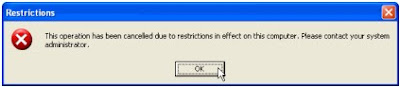
If you are configuring a Windows XP computer for new users or for public use, you may wish to disable access to the entire Control Panel so people cannot accidentally change settings that may cause problems such as making the screen unreadable, disabling devices, and disabling security features such as the Windows Firewall.
Conversely, you may be the victim of a spyware or other malware attack, or system files may have gotten corrupted, preventing access to the Control Panel. You may not even see a Control Panel option from the "Start" menu. This Registry tweak may solve your problem. This post contain manual steps to protect your computer and remove spyware
Trying to access a Control Panel applet that has been disabled
If your system is centrally managed via Group Policy Management, this tweak may have no effect.
Editing the Windows Registry may cause damage to your machine.
If your system is centrally managed via Group Policy Management, this tweak may have no effect.
Editing the Windows Registry may cause damage to your machine.
Follow the Steps
1. Open the Windows Registry Editor (Click "Start" - "Run" - "regedit.exe").
2. Navigate to the following key:
My Computer \ HKEY_CURRENT_USER \ Software \ Microsoft \ Windows \ CurrentVersion \ Policies \ Explorer
3. To prevent Control Panel access (you will not even be able to run .CPL files manually), create a new DWORD value named NoControlPanel with a value of 1.
To re-enable Control Panel access, delete the NoControlPanel value.
Especially when re-enabling disabled Control Panel access, you may have to logoff and back on or restart the machine for the change to take effect.
4. Close the Registry Editor.
2. Navigate to the following key:
My Computer \ HKEY_CURRENT_USER \ Software \ Microsoft \ Windows \ CurrentVersion \ Policies \ Explorer
3. To prevent Control Panel access (you will not even be able to run .CPL files manually), create a new DWORD value named NoControlPanel with a value of 1.
To re-enable Control Panel access, delete the NoControlPanel value.
Especially when re-enabling disabled Control Panel access, you may have to logoff and back on or restart the machine for the change to take effect.
4. Close the Registry Editor.
Wednesday, July 15, 2009
How to protect your computer against viruses
A computer virus is a small software program that spreads from one computer to another computer and that interferes with computer operation. A computer virus may corrupt or delete data on a computer, use an e-mail program to spread the virus to other computers, or even delete everything on the hard disk.This post provide virus removal tips to protect your PC.
To protect your computer against viruses, follow these steps:
1. On the computer, turn on the firewall.
2. Keep the computer operating system up-to-date.
3. Use updated antivirus software on the computer.
4. Use updated antispyware software on the computer.
For more information about how to protect a computer against viruses, visit the following Microsoft Web site: http://www.microsoft.com/protect/computer/default.mspx
To protect your computer against viruses, follow these steps:
1. On the computer, turn on the firewall.
2. Keep the computer operating system up-to-date.
3. Use updated antivirus software on the computer.
4. Use updated antispyware software on the computer.
For more information about how to protect a computer against viruses, visit the following Microsoft Web site: http://www.microsoft.com/protect/computer/default.mspx
Thursday, July 9, 2009
How to Guard Your Computer System From Spyware
What are Spyware
Spyware are malicious software programes, that can create havoc if they get activated on your computer system as they can track your personal data and sensitive information. They can make your computer systems go slow eating up your processing resource without your consent. This section contains the information for Spyware removal to prevent your PC to Spywares.
How Spyware Attacks
Most of spywares get installed without any user knowledge. Some time they comes with shareware software or other uncodable software. Normally user download free software but they do not know that spyware could also get downloaded with it. Spyware programs are intended to show some kind of advertisement. and display advertisement popup continuously. Generally advertisement companies fund and boost this kind of spywares to get a mileage or popularity by them. If by some means you have downloaded the one and clicked it, it gets activated and installed instantly. Some free internet toolbars could be spywares, they may add some new menu option, buttons, new taskbar icones, new items in favorites, excessive hyper links can added in you internet browser and it can also change your default web home page or you search engine. As far as spyware affect is considered it can make your computer processing slow making your computer take longer time to processing the task or startup time. To protect your PC use antivirus support software which is integrated with Spywares Protection?
Steps to Prevent Spywares
Step 1: Use AntiSpyware protection
Always use good antispyware and scan your computer system on daily basis. Now-a-days some antvirus come with integrated antispyware facility you can choose them as a precaution measure. If you are using Windows Vista there is a option to prevent spywares, you can use Windows Defender protection. It detect spywares and unwanted advertisement as well. If you are using Windows XP then also you can download Windows Defender from Microsoft website.
Step 2: Security settings of Internet Explorer
for better prevention of spyware keep your Internet explorer settings set on high level.
To adjust internet explorer security settings
> Open Internet Explorer
> click Tools
> click Internet Options
> Select the Security tab.
There are different kind of security zones with the help of which you can restrict those web site which cause your computer security loose.
Step 3: Do not click any link inside the pop-up:
During the Internet browsing many pop-up comes if they provide any link to click do not click them if you find your self suspicious of where you are going to land.
Step 4: Updating Software:
Keep your operating system updated with Windows Released Patches and Service Packs,
Step 5: Downloading
Always download whatever you want but only from trusted website. It might be possible that freeware software contain spywares. Do not install any suspicious toolbar or search engine.
Source:http://EzineArticles.com/?How-to-Guard-Your-Computer-System-From-Spyware&id=2486953
Spyware are malicious software programes, that can create havoc if they get activated on your computer system as they can track your personal data and sensitive information. They can make your computer systems go slow eating up your processing resource without your consent. This section contains the information for Spyware removal to prevent your PC to Spywares.
How Spyware Attacks
Most of spywares get installed without any user knowledge. Some time they comes with shareware software or other uncodable software. Normally user download free software but they do not know that spyware could also get downloaded with it. Spyware programs are intended to show some kind of advertisement. and display advertisement popup continuously. Generally advertisement companies fund and boost this kind of spywares to get a mileage or popularity by them. If by some means you have downloaded the one and clicked it, it gets activated and installed instantly. Some free internet toolbars could be spywares, they may add some new menu option, buttons, new taskbar icones, new items in favorites, excessive hyper links can added in you internet browser and it can also change your default web home page or you search engine. As far as spyware affect is considered it can make your computer processing slow making your computer take longer time to processing the task or startup time. To protect your PC use antivirus support software which is integrated with Spywares Protection?
Steps to Prevent Spywares
Step 1: Use AntiSpyware protection
Always use good antispyware and scan your computer system on daily basis. Now-a-days some antvirus come with integrated antispyware facility you can choose them as a precaution measure. If you are using Windows Vista there is a option to prevent spywares, you can use Windows Defender protection. It detect spywares and unwanted advertisement as well. If you are using Windows XP then also you can download Windows Defender from Microsoft website.
Step 2: Security settings of Internet Explorer
for better prevention of spyware keep your Internet explorer settings set on high level.
To adjust internet explorer security settings
> Open Internet Explorer
> click Tools
> click Internet Options
> Select the Security tab.
There are different kind of security zones with the help of which you can restrict those web site which cause your computer security loose.
Step 3: Do not click any link inside the pop-up:
During the Internet browsing many pop-up comes if they provide any link to click do not click them if you find your self suspicious of where you are going to land.
Step 4: Updating Software:
Keep your operating system updated with Windows Released Patches and Service Packs,
Step 5: Downloading
Always download whatever you want but only from trusted website. It might be possible that freeware software contain spywares. Do not install any suspicious toolbar or search engine.
Source:http://EzineArticles.com/?How-to-Guard-Your-Computer-System-From-Spyware&id=2486953
Wednesday, June 17, 2009
How to manually remove Spyware Protect 2009
The information in this post how to remove spyware Protect 2009 manually from the system. It also follow Spyware detection and removal support by Expert Technician
Follow the steps below:
Step 1:- Delete the suspicious file(s) or folder(s) from the computer
From Start > Search, then click on For Files and Folders
Click on All files and folders
Type the filenames on the search box, and choose the Local Hard Drives
Click on Search.
Search the following files :
sysguard.exe
sysguardn.exe
Uninstall Spyware Protect 2009.lnk
Step 2:- Manual Removal of suspicious entries from Registry.
Important This post contains information about how to modify the registry. Make sure that you back up the registry before you modify it. Make sure that you know how to restore the registry if a problem occurs
Click Start, Click run and type regedit.
Create a registry backup.
Locate the following registry keys, right click and Delete.
HKEY_CURRENT_USER\Software\Spyware Protect 2009
HKEY_CURRENT_USER\Software\sysguard.exe
HKEY_CURRENT_USER\Software\sysguardn.exe
Follow the steps below:
Step 1:- Delete the suspicious file(s) or folder(s) from the computer
From Start > Search, then click on For Files and Folders
Click on All files and folders
Type the filenames on the search box, and choose the Local Hard Drives
Click on Search.
Search the following files :
sysguard.exe
sysguardn.exe
Uninstall Spyware Protect 2009.lnk
Step 2:- Manual Removal of suspicious entries from Registry.
Important This post contains information about how to modify the registry. Make sure that you back up the registry before you modify it. Make sure that you know how to restore the registry if a problem occurs
Click Start, Click run and type regedit.
Create a registry backup.
Locate the following registry keys, right click and Delete.
HKEY_CURRENT_USER\Software\Spyware Protect 2009
HKEY_CURRENT_USER\Software\sysguard.exe
HKEY_CURRENT_USER\Software\sysguardn.exe
Tuesday, June 2, 2009
Symantec has identified a third variant of the worm Conficker
Conficker / Downadup reappears in a new version. Targeting already infected machines and not updates, W32 Downadup.C act as Trojan horse for other viruses and worms to contaminate.The security experts from the publisher Symantec detected a new version of the worm Conficker / Downadup, the third in less than three months. According to their preliminary findings, this variant, called the W32 Downadup.C, "addressing itself only to machines already infected with early versions of Conficker and would be even more virulent.Disabling antivirus and anti-spyware, opening of ports and creation of a gap to allow other viruses and Trojans, Conficker 3 was designed to better defend themselves against the tools to eradicate it and seems yet fulfill its promise."A module more aggressive" according to SymantecAccording to Vincent Weafer, vice president of Symantec Security Response, has to be seen "as a module update that is more aggressive, more robust to defend itself."Conficker has already infected more than nine million Windows PCs in the world and this new version could push that figure even if we think at Symantec W32 Downadup.C that aims to infect even more machines which have not been updated.Known methods to get rid of them is still valid, so it is advisable to scan your machine with an updated anti-virus and with the removal tool malware Microsoft, then apply the patches available online.
How to manually remove Virus Protector 2008
Virus Protector 2008, also known as VirusProtector2008, is one of the latest counterfeit antispyware. It usually comes up after you installed a video codec that come with Trojan, malware and virus. You might get infected by visiting some malicious websites.
Step 1 : Stop Virus Protector 2008 Processes:
Press Alt+Ctrl+Delete, then click on Task Manager.
Select the process VirusProtector2008.exe and VP2008.exe , then click on End Process
Step 2: Find and Delete these Virus Protector 2008:
Click Start and then click on Search, then click on All Files and Folders
Type the filenames
VirusProtector2008.exe
VirusProtector2008.lnk
VP2008.exe
Uninstall VirusProtector2008.lnk
Delete files one by one
Step 3 :Remove Virus Protector 2008 Registry Values:
Important This post contains information about how to modify the registry. Make sure that you back up the registry before you modify it. Make sure that you know how to restore the registry if a problem occurs. Below given steps if unavailable for modify the registry so simply visit this spyware removal services sites to take tips
Click Start and then click on Run
Type in Regedit
Locate and delete the following registry value.
HKEY_CURRENT_USER\Software\Surround Software Solutions\Virus Protector 2008
HKEY_CURRENT_USER\Software\CrucialSoft Ltd
HKEY_CURRENT_USER\Software\CrucialSoft Ltd\Virus Protector 2008
HKEY_CURRENT_USER\Software\Microsoft\Windows\CurrentVersion\uninstall\Virus Protector 2008 5.7
HKEY_CURRENT_USER\Software\Microsoft\Windows\CurrentVersion\Run ?Virus Protector 2008
Close Registry editor
Step 1 : Stop Virus Protector 2008 Processes:
Press Alt+Ctrl+Delete, then click on Task Manager.
Select the process VirusProtector2008.exe and VP2008.exe , then click on End Process
Step 2: Find and Delete these Virus Protector 2008:
Click Start and then click on Search, then click on All Files and Folders
Type the filenames
VirusProtector2008.exe
VirusProtector2008.lnk
VP2008.exe
Uninstall VirusProtector2008.lnk
Delete files one by one
Step 3 :Remove Virus Protector 2008 Registry Values:
Important This post contains information about how to modify the registry. Make sure that you back up the registry before you modify it. Make sure that you know how to restore the registry if a problem occurs. Below given steps if unavailable for modify the registry so simply visit this spyware removal services sites to take tips
Click Start and then click on Run
Type in Regedit
Locate and delete the following registry value.
HKEY_CURRENT_USER\Software\Surround Software Solutions\Virus Protector 2008
HKEY_CURRENT_USER\Software\CrucialSoft Ltd
HKEY_CURRENT_USER\Software\CrucialSoft Ltd\Virus Protector 2008
HKEY_CURRENT_USER\Software\Microsoft\Windows\CurrentVersion\uninstall\Virus Protector 2008 5.7
HKEY_CURRENT_USER\Software\Microsoft\Windows\CurrentVersion\Run ?Virus Protector 2008
Close Registry editor
Wednesday, May 27, 2009
How to manually block files or sites in Spyware Doctor with Antivirus
This post describes how to manually block files or sites using Spyware Doctor with Antivirus.
Spyware Doctors Global action list enables users to manually block files and sites. Make sure IntelliGuard / IntelliGuard is completely activated and simply add the file or site you wish to block.
Follow the steps below:
Open Spyware Doctor and select the 'Settings' button >> 'Global Action List'.
Click the 'Add' button and the 'Add New Rule' box will appear.
At the ' Select data type: ' dropdown box make sure you select 'File on disk' or 'Web site address/cookie'.
Browse for the 'executable file' (.exe file) that opens and runs the application in question or type the URL you wish to block.
Once the file or site is selected, at the bottom dropdown box make sure ' Always block ' is selected, then click the 'Add' button.
The file or site is now added and will be blocked by IntelliGuard / IntelliGuard.
Related Search
How to Update Spyware Doctor
How to manually remove Virus Protector 2008
Spyware Removal Services
How to uninstall Spyware Doctor
Spyware Doctors Global action list enables users to manually block files and sites. Make sure IntelliGuard / IntelliGuard is completely activated and simply add the file or site you wish to block.
Follow the steps below:
Open Spyware Doctor and select the 'Settings' button >> 'Global Action List'.
Click the 'Add' button and the 'Add New Rule' box will appear.
At the ' Select data type: ' dropdown box make sure you select 'File on disk' or 'Web site address/cookie'.
Browse for the 'executable file' (.exe file) that opens and runs the application in question or type the URL you wish to block.
Once the file or site is selected, at the bottom dropdown box make sure ' Always block ' is selected, then click the 'Add' button.
The file or site is now added and will be blocked by IntelliGuard / IntelliGuard.
Related Search
How to Update Spyware Doctor
How to manually remove Virus Protector 2008
Spyware Removal Services
How to uninstall Spyware Doctor
Tuesday, May 19, 2009
How to Update Spyware Doctor
The problem you are experiencing is generally due to one of the following reasons: This post provide Spyware support for update Spyware Doctor
Check that you have the latest version of Spyware Doctor: Check the latest version of Spyware Doctor. ou can check the version number by clicking on the 'Status' button.
Spyware Doctor settings configured to 'Direct Connection'
Follow the steps below to allow a direct connection to Smart Update within Spyware Doctor.
Go to 'Settings' in Spyware Doctor.
Choose 'General'.
Click 'Proxy Settings' on the right hand side.
Check the option 'Use Direct Connection'.
Internet Connection - Ensure you are connected to the Internet when attempting to perform a Smart Update.
Firewall / Proxy Server - You may need to temporarily disable your firewall or proxy server to perform Smart Update, as these programs can sometimes interpret the update function as a malicious process. If your software supports it, can you please place 'pctsGui.exe', 'pctsSvc.exe' and 'update.exe' on your firewall or proxy server's 'Allowed Processes' list. This will permit you to run future Smart Update with your firewall or proxy server enabled.
Virus Scanner - You may need to temporarily disable your virus scanner to perform a Smart Update, as these programs can sometime determine the download as a malicious process. Please remember to re-enable your Virus Scanner when Smart Update has completed.
Check that you have the latest version of Spyware Doctor: Check the latest version of Spyware Doctor. ou can check the version number by clicking on the 'Status' button.
Spyware Doctor settings configured to 'Direct Connection'
Follow the steps below to allow a direct connection to Smart Update within Spyware Doctor.
Go to 'Settings' in Spyware Doctor.
Choose 'General'.
Click 'Proxy Settings' on the right hand side.
Check the option 'Use Direct Connection'.
Internet Connection - Ensure you are connected to the Internet when attempting to perform a Smart Update.
Firewall / Proxy Server - You may need to temporarily disable your firewall or proxy server to perform Smart Update, as these programs can sometimes interpret the update function as a malicious process. If your software supports it, can you please place 'pctsGui.exe', 'pctsSvc.exe' and 'update.exe' on your firewall or proxy server's 'Allowed Processes' list. This will permit you to run future Smart Update with your firewall or proxy server enabled.
Virus Scanner - You may need to temporarily disable your virus scanner to perform a Smart Update, as these programs can sometime determine the download as a malicious process. Please remember to re-enable your Virus Scanner when Smart Update has completed.
Subscribe to:
Posts (Atom)

